

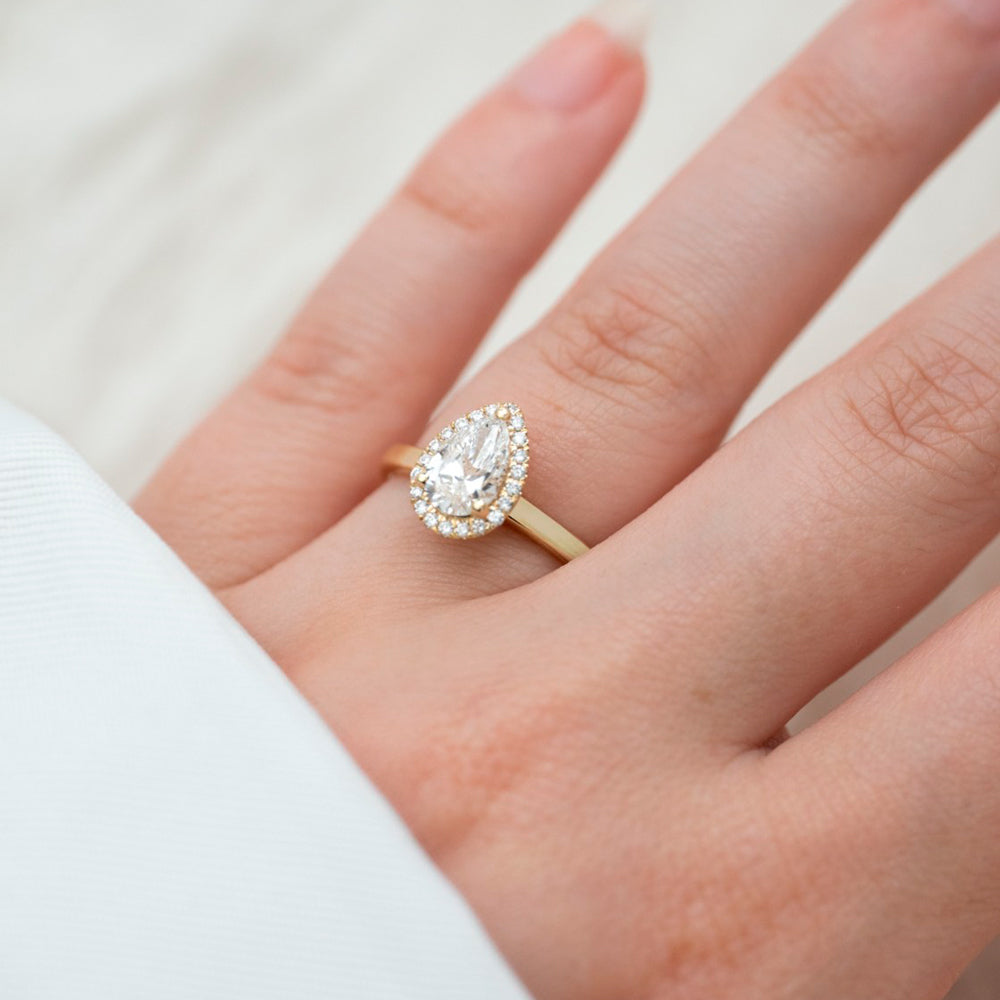

The choice that lasts a lifetime
An engagement ring is not just a piece of jewellery. It is a promise – and it needs to fit right, look right and feel right, both on the day it is given and many years after.
Yet for many, it is a choice that can feel overwhelming. What is the difference between 14 and 18 carat? What is a lab grown diamond? And is size the most important factor – or is it the metal?
This guide answers all of it. We walk you through the four most important parameters – size, metal, stone and budget – and give you the knowledge you need to choose the right ring.
At Nordahl Andersen we work with a broad portfolio of brands and collections, all of which can be experienced at our retailers around the country. Here you will find personal guidance and the opportunity to try on the rings.
How to find the right size
Ring size is measured by the inner diameter in millimetres or as a ring gauge. Here are the most common sizes and what they correspond to
49 - XS/S
Inner diameter approx. 15.6 mm. Typically fits slim or short fingers. One of the most common sizes for women.
52 - S/M
Inner diameter approx. 16.6 mm. The most common size for women in Denmark. A good starting point if you are unsure.
54 - M/L
Inner diameter approx. 17.2 mm. Fits wider or longer fingers. Remember that fingers swell slightly in the heat.
Good to know
Fingers change throughout the day – they are largest in the evening and in warm weather. Always measure ring size in the afternoon and at room temperature for the most accurate result. Most rings can afterwards be resized up or down by half to a full size by a jeweller.
Choice of metal
The metal does not just determine the colour of the ring – it also affects durability, care and price. Here are the four most commonly used metals for engagement rings.
Choice of stone
The stone is often the first thing the eye is drawn to – and the choice is far more personal than many think. Here are the most commonly used stones for engagement rings and what sets them apart.
Diamond
The most classic stone for engagement rings. The diamond is the hardest stone in existence and creates a unique play of light. Quality is assessed based on the four C's: Cut, Colour, Clarity and Carat.
Rubin
The red ruby symbolises love and passion. A ruby in an engagement ring is a personal and striking choice that stands out from the classic.
Saphire
The sapphire is the second hardest stone after the diamond and comes in many colours – the classic deep blue is the most common. Known from among others Diana and Kate Middleton's engagement ring.
Emerald
The green emerald is one of the most precious stones and gives the ring a romantic, almost vintage expression. Particularly well suited to gold-coloured metals.
Cubic zirconia
Cubic zirconia is a synthetic stone that closely resembles a diamond. A popular choice for those who want a diamond-like appearance at a lower price.
Pearl
A pearl in an engagement ring is a timeless and feminine choice. The pearl is organic and unique – no two are alike – and gives the ring a soft, romantic expression.
Cut
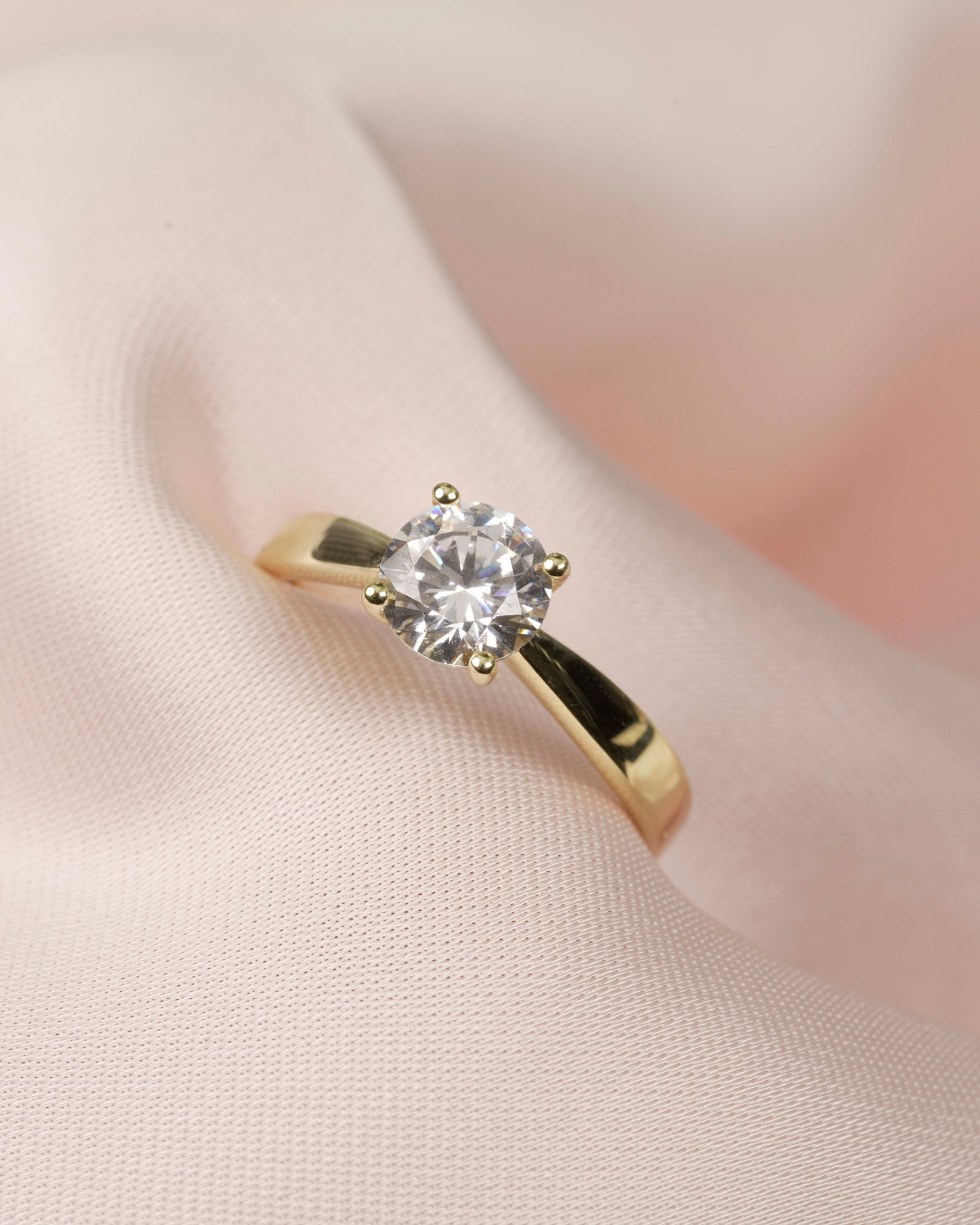
Briliant cut
The round classic with 57 facets. Most play of light and most timeless. Suits all styles.
Princess cut
Square with pointed corners. Modern and striking with a clean, crisp expression.
Oval cut
Elongates the finger and gives an elegant silhouette. One of the most popular choices today.
How much does an engagement ring cost?
The prices of engagement rings vary enormously. Here is a guide to what you can typically expect at different budgets – and what the money goes towards.

Simple and beautiful
€400–€1.050
A good budget for a classic ring in 14 carat gold with a small diamond or lab grown stone. Many beautiful options in this price range.
Explore collection
The wide selection
€1,050 – €2,680
Here the selection opens up significantly. You will find rings with natural or lab grown diamonds of good quality, in 14 or 18 carat gold.
Explore collection
Premium
€2,680
Larger or higher quality diamonds, white gold, platinum and unique design rings. The craftsmanship and choice of materials are top of the range.
Explore collection
Labgrown diamonds
Here is what you should know – without us taking a stance on what the "right" choice is. That is entirely personal.
01. Chemically identical to natural diamonds
Lab grown diamonds consist of exactly the same material as natural diamonds – pure carbon in crystalline form. They are not the same as cubic zirconia or other imitation stones.
02. Significantly lower price
A lab grown diamond typically costs 50–80% less than a comparable natural diamond. This means you can get a larger or higher quality stone for the same money.
03. A traceable choice
Lab grown diamonds have a documented origin. Many choose them on this basis as there is no uncertainty about mining conditions.
04. Certified and graded
Just like natural diamonds, lab grown diamonds are sold with a certificate from recognised laboratories such as GIA or IGI, stating the four C's.

Explore our wide selection of engagement rings




Frequently asked questions
Can I have my ring resized afterwards?
Can I have my ring resized afterwards?
Yes, most rings can be resized by a jeweller. Typically a ring can be adjusted up or down by half to a full size without any problems. Rings with stones all the way around the band are more difficult to resize.
What is the difference between an engagement ring and a wedding ring?
What is the difference between an engagement ring and a wedding ring?
The engagement ring is given at the engagement and typically worn alone. The wedding ring is given at the wedding and usually worn on a different finger or together with the engagement ring. Many choose rings that match visually.
Do I need to know my partner's ring size in advance?
Do I need to know my partner's ring size in advance?
Not necessarily. Many choose an average size and have the ring adjusted afterwards. A good retailer can advise on how to discreetly find out the size – or on buying a ring that can easily be adjusted.
Are lab grown diamonds the same as synthetic stones?
Are lab grown diamonds the same as synthetic stones?
No. Lab grown diamonds, also known as synthetic diamonds, are not the same as moissanite, cubic zirconia or other imitations. They are chemically and physically identical to natural diamonds, simply created in a laboratory instead of deep within the earth.
How long does it take to order an engagement ring?
How long does it take to order an engagement ring?
Rings in stock can typically be purchased immediately. Special order rings or rings with specific requests can take from 2–8 weeks depending on the manufacturer and design. Plan ahead if you have a date in mind.
How do I care for my engagement ring?
How do I care for my engagement ring?
Clean the ring regularly with lukewarm water and mild soap. Remove it during heavy physical work, when in contact with chemicals and when playing ball sports. Have it cleaned and checked by a jeweller once a year to ensure the stone is secure.